
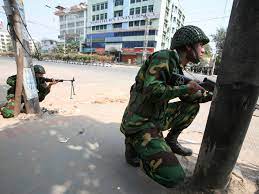
Dhaka: A commission investigating the 2009 Bangladesh Rifles (BDR) mutiny has claimed that former Prime Minister Sheikh Hasina personally ordered the revolt that left 74 people dead, including senior military officers, just weeks after she returned to power. The findings, released on Sunday, have escalated pressure on the 78-year-old leader, who is already facing a death sentence in absentia for “crimes against humanity” linked to last year’s protests.
The panel, formed by the Muhammad Yunus-led interim administration following Hasina’s ouster, re-examined the violent two-day mutiny that erupted in Dhaka and quickly spread nationwide. Commission chief ALM Fazlur Rahman alleged that the then-Awami League government orchestrated the revolt. He named former MP Fazle Noor Taposh as the “principal coordinator” acting on Hasina’s orders, claiming she gave the “green signal” for the killings.
Alleged Foreign Involvement
Rahman also accused a foreign power of involvement, stating, “The conspiracy aimed to weaken this force and destabilise Bangladesh. At that time, India sought to create instability while the then government sought to extend its rule.” He clarified that the neighbouring country in question was India, noting that Hasina and several party leaders had taken refuge there following the mutiny.
According to Rahman, around 921 Indians entered Bangladesh during the period, with 67 unaccounted for—a claim presented as evidence of Indian involvement. India has not responded to the allegations, which come amid already strained bilateral ties following Hasina’s flight to India after the 2024 anti-government protests.
Political Reactions
Muhammad Yunus welcomed the report, stating, “Through the commission report, the truth has finally been revealed.” Previously, investigations under Hasina’s government attributed the mutiny to long-standing resentment among soldiers over pay and treatment. Political rivals, however, have long maintained that Hasina used the mutiny to tighten control over the military.
Bangladesh has also renewed its call for Hasina’s extradition. Foreign Affairs Advisor Mohammad Touhid Hossain told reporters in Dhaka that while bilateral relations should not hinge on a single issue, Hasina’s repatriation from India remains a priority. Hasina was sentenced to death in absentia on November 17 for “crimes against humanity” linked to her government’s crackdown on student-led protests last year.