The Indian Institute of Management (IIM) Nagpur recently became the centre of a major controversy that has raised questions about student autonomy, institutional discipline, and campus governance. What began as a social gathering quickly escalated into a disciplinary crisis, leading to hundreds of students protesting and boycotting mid-term examinations. The incident has captured widespread attention across the academic community and beyond.
In this article, we unpack the sequence of events, examine the reactions from both students and the institute, explore the implications for campus discipline policies, and reflect on what this means for student-institution relations in elite management schools.
What Happened at IIM Nagpur?
On the night of February 14, a group of around 70–75 MBA students from both the first and second year batches attended a pool party at an off campus resort. The event was reportedly organised by student clubs as a farewell gathering for the outgoing second year cohort. Students stayed at the resort overnight and returned to campus the next morning. According to institute authorities, their movement register stated they were travelling home, but in reality they had attended the party without prior permission from the administration.
IIM Nagpur has strict rules for campus residents requiring students to return before 10 pm and to obtain prior approval if they plan to be off campus for any reason. Staying outside beyond curfew without official sanction is considered a violation of hostel and institutional regulations.
Disciplinary Action: Barred From Exams
As a disciplinary measure, the institute sent an official communication stating that around 70–75 first-year MBA students who had attended the unsanctioned resort outing would not be allowed to sit for their mid-term examinations scheduled from February 24. Second-year students were informed they could attend their final examinations scheduled from February 25, provided they had obtained prior permission or were not part of the group that violated rules.
The institute also reached out to the parents of female students who had attended the party, indicating that hostel rules had been violated. This step drew immediate criticism from the student community, who questioned why only female students’ parents were contacted, suggesting an element of discriminatory treatment.
According to the administration, strict action was necessary to uphold discipline and safety on campus, while also clarifying that efforts would be made to ensure that students’ longer term academic careers are not negatively impacted. Rescheduled examinations for the affected students were promised at a later date.
Student Reaction and Protest
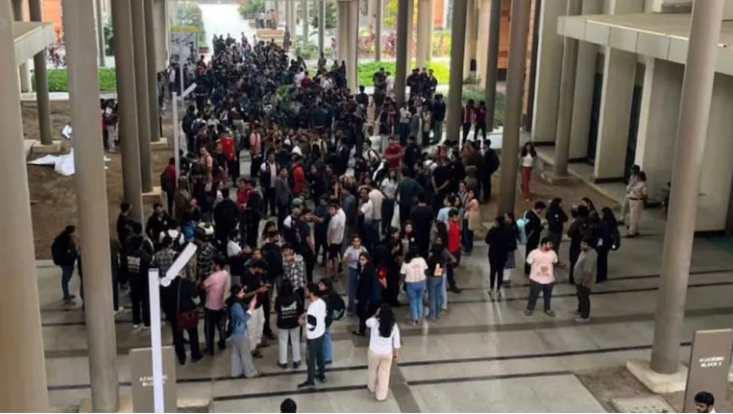
The disciplinary action triggered a strong response from the student body. What began as concern quickly turned into collective discontent. Nearly 400 students from both first- and second-year batches staged a silent protest on campus. Many students expressed their frustration at what they perceived as disproportionate punishment for attending a social event, especially given that some clubs had informed campus authorities about the outing in advance.
Students argued that being barred from an exam a significant component of academic evaluation could adversely affect their academic performance and future prospects. Some also raised concerns about inconsistent application of rules, questioning whether the punishment truly matched the violation.
At one point, scores of first-year students chose to boycott their mid term examinations in solidarity with their barred peers, with some second-year students joining the protest out of concern that they, too, might face disciplinary action. The protest was described by many as a rare show of unity among students at a premier management institute.
Amid the friction, the controversy highlighted larger questions about student rights, due process, and the balance between discipline and empathy in academic settings.
Controversy Over Communication and Gender Bias
One of the flashpoints of the controversy was the institute’s decision to contact the parents of female students specifically. Many students felt that this step reflected a bias, arguing that male students’ parents were not similarly informed. They questioned whether this differentiated treatment reinforced stereotypes about female safety and behaviour, and whether it was necessary or appropriate given the situation. Such concerns added another layer to the discourse around the disciplinary action, drawing attention to how institutional policies are communicated and enforced.
Institutional Perspective
From the institute’s standpoint, maintaining discipline and ensuring the safety and accountability of students is of paramount importance. Curfew rules and movement regulations are typically put in place to prevent risky situations, ensure adequate supervision, and promote academic focus among students. The administration maintained that students were aware of the rules and that violating them, particularly by falsely recording travel details, constituted a serious infraction.
Officials also stressed that the punitive action was not intended to derail academic careers permanently. The promise to reschedule the examinations for the affected students signalled a willingness to balance discipline with academic fairness though not all students were satisfied with this approach.
Implications for Campus Governance
The incident raises broader questions about governance in higher education institutes, particularly in highly competitive and elite environments such as IIMs. Key considerations include:
1. Clarity of Rules and Expectations:
Institutes must ensure that students are fully aware of regulations and the consequences of violations. Miscommunication or ambiguity can lead to unintended infractions.
2. Proportionality of Punishment:
Disciplinary measures need to be proportionate to the violations. Exclusion from examinations a core academic requirement is a serious consequence and warrants careful consideration by any institution.
3. Transparency in Enforcement:
Students expect fair and transparent processes. Any perception of bias such as gender-based differential communication can deepen mistrust and campus unrest.
4. Student-Institution Dialogue:
Effective communication channels between students and administrators can help resolve conflicts before they escalate. Shared governance and constructive dialogue are essential components of healthy campus culture.
Looking Forward
Ultimately, most students affected by the exams boycott have been assured a new date for sitting their missed mid-term papers. The institute has indicated that the situation has been resolved to an extent, with academic schedules for second-year students proceeding as planned.
However, the controversy is likely to stay relevant across academic circles as a case study in institutional discipline, student solidarity, and the complexities of managing behavioural expectations within professional education.
For prospective students, parents, and academic professionals, this incident serves as a reminder that rules and regulations no matter how well intentioned must be balanced with empathy, fairness, and transparent communication.
Disclaimer: This article presents an independent analysis of reported events and does not represent any official position of the institutions or individuals mentioned.