
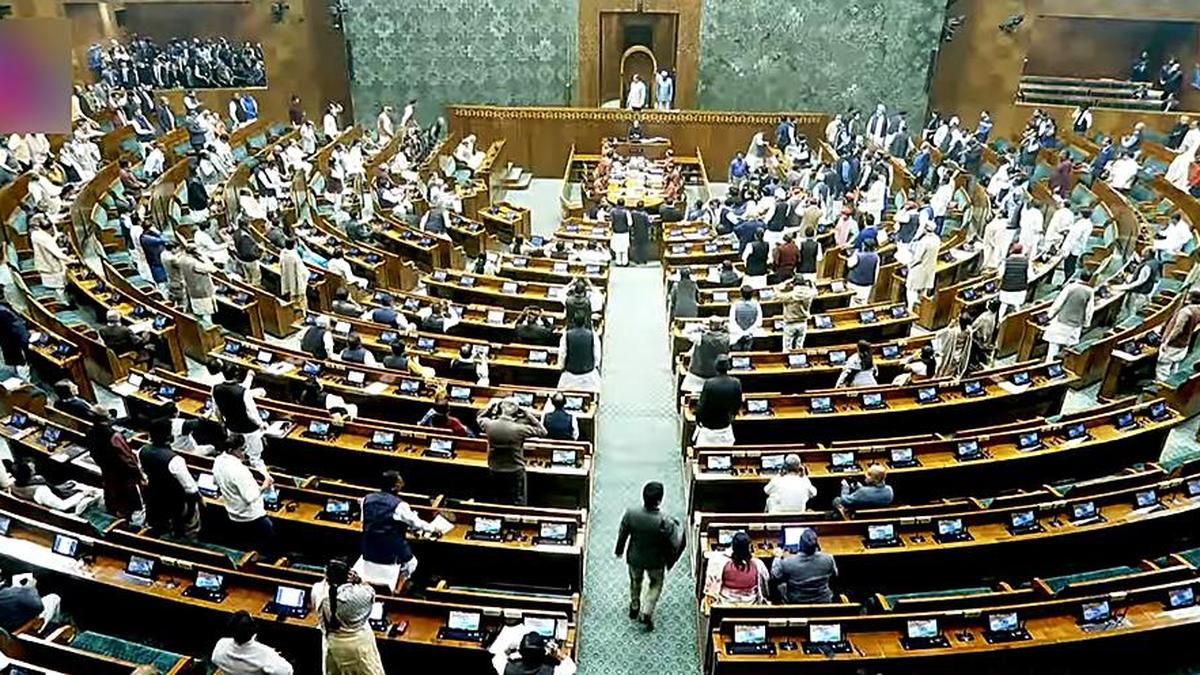
The Winter Session of Parliament begins today, with the government set to move ahead on a wide-ranging reform agenda — including opening India’s civil nuclear sector to private participation for the first time.
The three-week session, scheduled to conclude on December 19, will feature 15 sittings. Alongside the legislative push, the Opposition is gearing up to confront the government over the Special Intensive Revision (SIR) of electoral rolls across 12 states and Union Territories, while also demanding discussions on air pollution in the National Capital Region.
Parliamentary Affairs Minister Kiren Rijiju convened an all-party meeting on Sunday to streamline floor coordination ahead of the session.
Key Bills on Government’s Agenda
The session’s major highlight is The Atomic Energy Bill, 2025, which aims to regulate the peaceful use of atomic energy while allowing private sector participation in a domain historically controlled by the state. The move follows the BJP-led NDA’s strong performance in the Bihar Assembly elections, which is expected to bolster the government’s reform momentum after disruptions in the previous session.
Several other major bills are listed for consideration:
Higher Education Commission of India Bill — to establish a single regulator for higher education institutions and universities, promoting transparency, autonomy and accreditation reforms.
Corporate Laws (Amendment) Bill, 2025 — revising the Companies Act, 2013, and LLP Act, 2008 to enhance ease of doing business.
National Highways (Amendment) Bill — aimed at faster and more transparent land acquisition for highway projects.
Securities Markets Code (SMC) Bill, 2025 — set to consolidate multiple financial market acts into a unified regulatory framework.
The government is also expected to prioritise amendments to the Arbitration and Conciliation Act, particularly Section 34 — an issue sent to a committee following a Supreme Court observation on director liability.
The first Supplementary Budget of the fiscal year is also slated for discussion.
Last week, the government rolled back a proposal allowing the President to establish regulations for the Union Territory of Chandigarh, after strong objections from several political parties — a signal that the session may remain politically charged.
Opposition Plans to Push SIR, National Security and Air Pollution
Opposition parties have made it clear that discussion on the Special Intensive Revision of electoral rolls must be included in the session agenda.
Samajwadi Party leader Ram Gopal Yadav declared:
“We will not allow the House to function if a discussion on SIR does not take place.”
Leaders from the TMC, DMK, and CPI have also raised red flags over transparency in the voter-list revision process.
TMC MP Kalyan Banerjee questioned the parliamentary structure, saying:
“If Parliament functions only with the government’s consent, then what value does the Opposition hold?”
He also criticised the allocation of parliamentary time, arguing that around 70% of discussion time is cornered by treasury benches.
Congress MPs Gaurav Gogoi and Jairam Ramesh accused the ruling party of “weakening parliamentary traditions” and avoiding meaningful debate on national issues.