Introduction
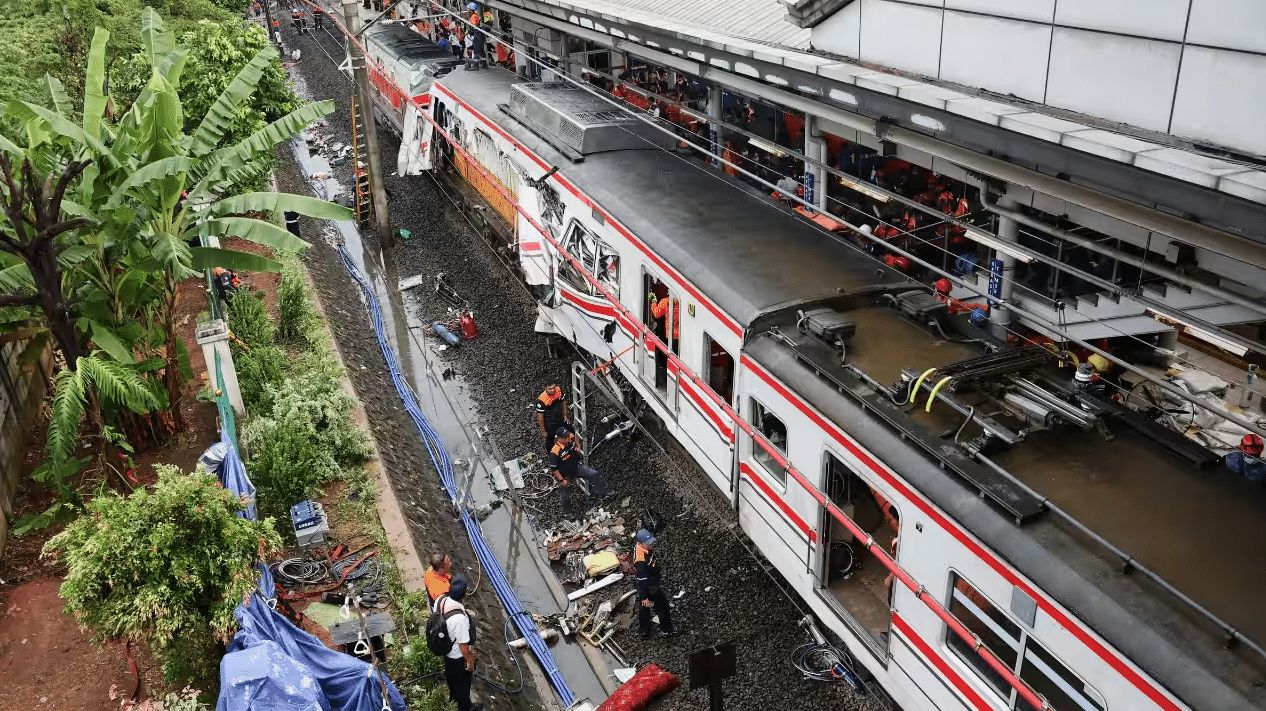
A tragic train collision near Jakarta, Indonesia, has once again highlighted serious concerns about railway safety in the region. What initially appeared to be a smaller has now escalated into a major disaster, with 14 people confirmed dead and more than 80 injured.
The accident occurred in Bekasi, a densely populated area just outside the capital, disrupting transportation and sparking nationwide concern.
What Happened? Full Incident Breakdown
The crash took place late on April 27, 2026, at Bekasi Timur Station, involving:
- A commuter train
- A long-distance train
Reports suggest that the commuter train had stopped after hitting a taxi stuck on the tracks, leading to a chain reaction. Shortly after, a long-distance train crashed into the stationary commuter train.
The impact was severe, particularly affecting a women-only carriage, which suffered the most damage.
Casualties and Damage
- Deaths: 14 confirmed
- Injured: 80+ passengers
- Severely affected: Women-only coach
Most victims were passengers inside the commuter train, while all 240 passengers on the long-distance train were reported safe.
Emergency responders had to cut through twisted metal to rescue trapped victims, indicating the intensity of the collision.
Rescue Operations: A Race Against Time
Rescue teams, including Indonesia’s national disaster response units, worked through the night:
- Specialized teams used heavy equipment to extract survivors
- Multiple ambulances transported injured passengers
- Evacuation was completed after several hours
Officials described the process as “delicate and complex” due to severely damaged train compartments.
By the next morning, authorities confirmed that no more passengers were trapped.
Possible Causes of the Crash
Preliminary findings indicate a chain-reaction accident:
- A taxi stalled on the railway crossing
- A commuter train collided with the vehicle
- Another train stopped due to the obstruction
- A long-distance train crashed into the stationary train
This sequence points to multiple failures, including:
- Poor railway crossing management
- Lack of automated warning systems
- Possible communication gaps
Investigations are currently being conducted by Indonesia’s National Transportation Safety Committee.
Infrastructure Concerns in Indonesia
This accident is not an isolated incident. Indonesia’s railway system has faced repeated criticism due to:
- Aging infrastructure
- Overcrowded commuter lines
- Limited safety modernization
A similar train crash in 2024 also resulted in fatalities, raising questions about long-term safety reforms.
Following the latest tragedy, authorities have promised infrastructure upgrades, including building flyovers at railway crossings.
Economic and Social Impact
The crash has had widespread consequences:
- Disruption of daily commuting in Jakarta
- Panic among families searching for loved ones
- Increased scrutiny on public transport safety
Commuter trains are a lifeline for Jakarta’s working population, making such incidents particularly impactful.
Government Response and Next Steps
Indonesia’s leadership has responded quickly:
- A formal investigation has been launched
- Safety audits of railway crossings are expected
- Plans for infrastructure upgrades have been announced
However, experts argue that systemic reforms, not just temporary fixes, are necessary to prevent future disasters.
Conclusion
The Jakarta train crash is a stark reminder of how infrastructure gaps and safety failures can lead to catastrophic consequences. While rescue operations have concluded, the real challenge lies ahead—ensuring such a tragedy does not happen again.
As investigations continue, the focus must shift toward modernizing railway systems, improving safety protocols, and strengthening accountability.