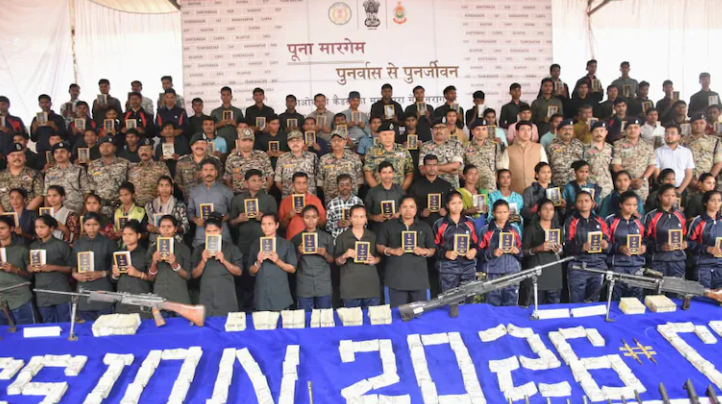
A major development in India’s fight against Left Wing Extremism unfolded in Bastar district of Chhattisgarh, where 108 Maoists surrendered to security forces, marking one of the largest mass surrenders in recent years. The insurgents collectively carried a bounty of ₹3.95 crore, making the event a significant breakthrough in anti Maoist operations.
Massive Surrender in Bastar Region
The surrender took place in Jagdalpur, the headquarters of the Bastar division, before senior police officials and security personnel. Many of the surrendered cadres were reportedly associated with the Dandakaranya Special Zonal Committee, one of the most influential wings of the outlawed Communist Party of India (Maoist).
Officials said that this development is a major boost to ongoing efforts to curb Maoist activity in the region, which has long been a stronghold of the insurgent movement.
Weapons, Cash and Gold Recovered
Along with the surrender, security forces recovered a massive cache of resources from Maoist hideouts. Authorities seized:
- ₹3.61 crore in cash
- 1 kg of gold worth about ₹1.64 crore
- More than 100 firearms and other weapons
Officials described the recovery as one of the largest seizures of cash and valuables from Maoist dumps in the country’s anti-Naxal operations.
Women Among the Surrendered Cadres
Out of the 108 Maoists who surrendered, 44 were women, highlighting the scale of participation in the insurgent group. The cadres came from several Maoist-affected districts in Bastar, including Bijapur, Dantewada, Sukma, Narayanpur, Bastar, and Kanker.
Authorities believe that the surrender will weaken Maoist manpower and disrupt their operational network in the region.
Linked to National Anti-Maoist Campaign
The mass surrender comes amid intensified operations against Maoist insurgents across central India. The government has been pushing aggressive security measures and rehabilitation programs encouraging militants to lay down arms and return to mainstream society.
Officials say the move is particularly significant as it comes close to the government’s target to eliminate Maoist influence in the country by March 31.
Impact on Maoist Movement
Security analysts say the surrender could have a major impact on the Maoist movement in the Bastar region. With more cadres leaving the armed struggle, the insurgency is expected to lose both operational strength and logistical support.
The government has also been promoting rehabilitation schemes that offer financial aid, education, and livelihood opportunities to surrendered militants.
Conclusion
The surrender of 108 Maoists in Bastar represents a major milestone in India’s long-running battle against Left-Wing Extremism. With large recoveries of weapons, cash, and gold, authorities believe the operation has significantly weakened the Maoist network in the region.
Security forces say sustained operations and rehabilitation policies will continue as part of efforts to ensure lasting peace and development in the Maoist-affected areas of central India.